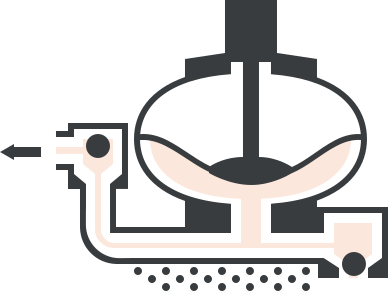
Diaphragm pump
Diaphragm pump is a special form of positive displacement pump. It relies on the back and forth agitation of a diaphragm to change the volume of the working chamber to inhale and discharge liquid.
The pneumatic diaphragm pump is mainly composed of two parts: the transmission part and the diaphragm cylinder head. The transmission part is the driving mechanism that drives the diaphragm back and forth. Its transmission forms include mechanical transmission, hydraulic transmission and pneumatic transmission, among which hydraulic transmission is widely used. The working part of the diaphragm pump is mainly composed of a crank connecting rod mechanism, a plunger, a hydraulic cylinder, a diaphragm, a pump body, a suction valve, and a discharge valve. Plug pumps are very similar.
When the diaphragm pump is working, the crank linkage mechanism drives the plunger to reciprocate under the drive of the motor, and the movement of the plunger is transmitted to the diaphragm through the working liquid (generally oil) in the hydraulic cylinder to make the diaphragm agitate back and forth.
The cylinder head part of the pneumatic diaphragm pump is mainly separated by a diaphragm to separate the conveyed liquid from the working liquid. When the diaphragm moves to one side of the transmission mechanism, the pump cylinder works under negative pressure and sucks liquid. When the diaphragm moves to the other side , the liquid is discharged. The liquid to be delivered is separated from the working liquid by the diaphragm in the pump cylinder, and only contacts the pump cylinder, suction valve, discharge valve and the pump side of the diaphragm, but does not contact the plunger and the sealing device, which makes the column Important parts such as plugs work completely in oil medium and are in good working condition.
The diaphragm must have good flexibility and good corrosion resistance, usually made of polytetrafluoroethylene, rubber and other materials. The pot-bottom-shaped parts with mesh holes on both sides of the diaphragm are set to prevent excessive local deformation of the diaphragm, and are generally called diaphragm limiters. The air-operated diaphragm pump has good sealing performance and can easily achieve leak-free operation. It can be used to transport corrosive liquids such as acids, alkalis, and salts, and high-viscosity liquids. A diaphragm is installed in each of the two symmetrical working chambers of the pump, which are connected as a whole by a central link. Compressed air enters the air distribution valve from the air inlet of the pump, and the compressed air is introduced into one of the chambers through the air distribution mechanism to push the diaphragm in the chamber to move, while the gas in the other chamber is discharged. Once the stroke end is reached, the valve mechanism automatically introduces compressed air into another working chamber, pushing the diaphragm to move in the opposite direction, so that the two diaphragms reciprocate continuously and synchronously.

Working Principle
When the volume of the pump chamber is increased (as the diaphragm moves up), the pressure drops. So, the fluid is drawn into the chamber. As the diaphragm moves down and volume decreases, the chamber pressure increases. Then, the drawn fluid is pushed out. Finally, the diaphragm, which moves again upwards, draws fluid into the chamber and completes the cycle. This procedure is similar to what occurs in an internal combustion engine.
Diaphragm Pumps provide a tight seal between the drive device and the compression chamber, enabling the pump to move, compress, and evacuate the medium without the need for lubrication.An elastomeric diaphragm is a versatile and dynamic seal that eliminates many other sealing methods limitations. In addition to not leaking, it offers little friction and can be created for low-pressure sensitivity. With suitable materials, diaphragms can seal over various pressures and temperatures without requiring lubricant or maintenance.
Types of Diaphragm pump
The diaphragm pumps are classified into different types such as
Air-Operated Pumps
Small Air-Operated Pumps
Small Motor Driven Pumps
Motor Driven Pumps
Wanner Hydra-Cell Pumps

Air-Operated Pumps
This is the most accepted diaphragm pump. The working of these pumps can be done by using compressed air. These pumps also include two assembly rooms with a diaphragm namely inlet check valve as well as an outlet check valve in every assembly room. The supply of air can be moved from one assembly room to another using an air spool control device that can be built into the pump.
This recurrent shifting process of air from one assembly room to another can forces fluid out of one assembly room & into the expulsion piping through the additional assembly room is being filled with fluid. There is some discharge flow pulsation within this pump, which can decrease a bit with pulsation dampeners within the discharge piping.
Small Air-Operated Pumps
The small air-operated pumps handle typical liquid viscosities & no pulp liquid focuses with ease. These pumps are used in low-volume liquid distribute accounts. The inlet & outlet ports of these pumps have 3/8, 1/2, otherwise, 3/4 & flow rates are 2GPM to 10 GPM.
Small Motor Driven Pumps
The small motor driven pumps develop forces to 60 PSI & in some cases 100 PSI. This type of pump is designed in two separate styles. The primary one is the demanding style which comprises a fixed force switch to routinely end & begin the pump at precise force settings. This kind of style is very famous.
Wanner Hydra-Cell Pumps
This is the larger shaft driven pump, which will supply pressures to 1500 PSI otherwise 2500 PSI & flow rates to 36 GPM. These are designed with different metals as well as elastomers for acidic solutions, slurries, violent chemicals, abrasives, wettable powders, and hot fluids.
Characteristics of Diaphragm Pumps
Diaphragm pumps have the following notable specifications:
Good suction lift is an important characteristic. Some of them are low-pressure pumps with low discharges, while others are able to produce higher flow rates, depending on the diaphragm effective operation diameter and stroke length. They can work with a relatively high concentration of solid content of sludge and slurries.
Pump design separates the fluid from potentially sensitive internal pump components.Internal pump parts are often suspended and isolated within the oil to extent pump longevityDiaphragm pumps are suitable for running in abrasive and corrosive media to pump abrasive, corrosive, toxic, and flammable liquids.
Diaphragm pumps can deliver the discharge pressure up to 1200 bar.
Diaphragm pumps have great efficiencies, up to 97%.
Diaphragm pumps can be used in artificial hearts.
Diaphragm pumps offer proper dry running characteristics.
Diaphragm pumps can be applied as filters in small fish tanks.
Diaphragm pumps have excellent self-priming capabilities.
Diaphragm pumps can work appropriately in highly viscous liquids.
Applications
Due to the above characteristics of the pneumatic diaphragm pump, the diaphragm pump is gradually invading the market of other pumps since its birth, and occupies an important part of it. Such as: Diaphragm pumps have occupied an absolute dominant position in the painting and ceramic industries.
Using compressed air as the power source, it can be used for various corrosive liquids. Different materials can be used according to different liquid media to meet the needs of different users.
The pump will not overheat: compressed air is used as power, and it is a process of expansion and heat absorption when the exhaust is exhausted. The temperature of the pneumatic pump is lowered when it is working, and no harmful gas is discharged.
No electric sparks: the pneumatic diaphragm pump does not use electricity as power, and prevents static sparks after being grounded
Liquids containing particles can pass through: because of the volumetric work and the inlet is a ball valve, it is not easy to be blocked.
The shear force on the material is extremely low: how to suck in and how to spit out when working, so the agitation of the material is minimal, and it is suitable for the transportation of unstable materials
The flow rate can be adjusted, and a throttle valve can be installed at the material outlet to adjust the flow rate.It has the function of self-priming.
Can be run dry without danger.
Can dive for work.
The fluid that can be transported is extremely wide, from low viscosity to high viscosity, from corrosive to viscous.No complicated control system, no cables, fuses, etc.
Small size, light weight, easy to move.
It is easy to maintain without lubrication, and will not pollute the working environment due to dripping.
The pump is always efficient and does not degrade due to wear.
100% energy utilization, when the outlet is closed, the pump will stop automatically, and the equipment will move, wear, overload, and generate heat
No dynamic seal, easy maintenance to avoid leakage. There are no dead spots when working.
Advantages and Disadvantages of Diaphragm Pumps
The diaphragm pump advantages include the following.
Reasonable maintenance will avoid some expensive repairs and failures.
Self-priming
Explosion proof
Changeable flow rate and expulsion pressure
Portable and easy for installation
They can operate in the long term
These are energy-efficient as they apply extra force while the forward hit of the pump.
These are well suited for pumping chemicals except for other harming fluids
These pumps are suitable to conquer standing force within the flow line.
The diaphragm pump disadvantages include the following.
Most of the diaphragm pumps need approximately 20 typical cubic-feet for each minute & 100 PSI of air intake for operating powerfully.
These pumps are inclined not to push extremely accurate at their base end.Due to the diaphragm pump pulsates, a dampener has to be fixed on top of the pump to decrease pulsing.
 Ball Valve
